At the start of a new year, we wanted to look back on the previous 12 months – a year marked by significant global political and economic turbulence, dominated by Donald Trump’s return to the US presidency, the ongoing wars in Ukraine and Gaza, and major shifts in global trade and monetary policy – as well as looking ahead to what the next 12 months might bring. Therefore, as well as canvassing the companies we work with to get an insight into the current market, we have included some statistics and data from the surveys carried out during 2025. We hope you will find this resulting report interesting, and if you would like to discuss with us anything contained within it, we’d love to hear from you, so do please get in touch!
Hiring Plans
Each quarter, we ask our clients about their hiring plans – for both permanent and contract staff – over the next 3 months. The graphics below show the responses we received for each quarter of 2025, together with the hiring plans for the coming quarter. For added context, we have included the figures for the highest and lowest levels recorded since our surveys began.
For those clients that said they did intend to hire permanent staff in the first 3 months of 2026, we asked them what was driving that hiring, as well as about the seniority levels of the positions they would be looking to fill.
What is driving your hiring?

As we start 2026, it’s encouraging to see permanent hiring intentions at their highest level for over a year, with an increase in planned expansion driving a significant portion of that. Mid-level hires continue to be the focus for a lot of employers, but it’s concerning to see the lack of demand for junior talent continuing, perhaps in part due to the adoption of AI. Demand for contract staff also remains subdued. This could in part be explained by the increase in planned permanent hires, but does also perhaps continue to represent an unwillingness to invest in significant projects.
Graham Bruce, Director
As well as asking the companies we work with about their hiring intentions, we also continue to track the number of vacancies available in the UK, as a market indicator. The following is a graph showing data collated by the Office for National Statistics, for the number of vacancies available in the UK, across the past two years.

We’ve been hearing over the past two years that from a candidate perspective, conditions have been challenging, and the data supports this. A sustained decline in UK vacancy numbers has meant fewer available roles and increased competition, making job searches longer and more uncertain for many. However, the recent stabilisation in vacancy figures over the past six months may offer some hope, suggesting that the market has potentially reached the bottom of the cycle.
For employers, this period of relative stability presents an opportunity. With candidate availability remaining high and hiring demand subdued, businesses may be able to secure high-quality talent that would have been harder to attract in a more buoyant market. If vacancy levels begin to rise again, this talent is likely to become scarcer, particularly in specialist or senior roles.
Aidan Snow, Account Manager
Candidates Seeking Work
Each quarter, we survey the candidates that have registered with us (our database includes candidates that are both “active” and “passive”) to understand whether or not they were actively seeking a new role:
Will you be actively looking for work in 2026?
Will you be actively looking for work over the next 3 months?
For those candidates that responded to say that they would be looking for work during the first 3 months of 2026, we asked them for the level of seniority they considered themselves to be, in order to see how that matched with current client demand.

Before vacancies began to decline due to rising inflation, geopolitical tension and broader market contraction, the UK experienced a significant shortage of highly skilled professionals, when demand for specialist skills far outstripped available supply.
Recent data shows that the percentage of candidates looking for work has decreased over the past few months. This shift is noteworthy and may serve as an early warning signal. While vacancy volumes have softened, candidate mobility is also tightening, suggesting that supply-side pressures are beginning to re-emerge beneath the surface.
While the market is currently quieter, it would be short-sighted to assume that talent shortages are a thing of the past. A prudent view is that the UK is likely to face renewed competition for top-tier talent again in the not-too-distant future, once hiring demand begins to recover.
Jonathan Campion, Director
Looking Forwards, Looking Back
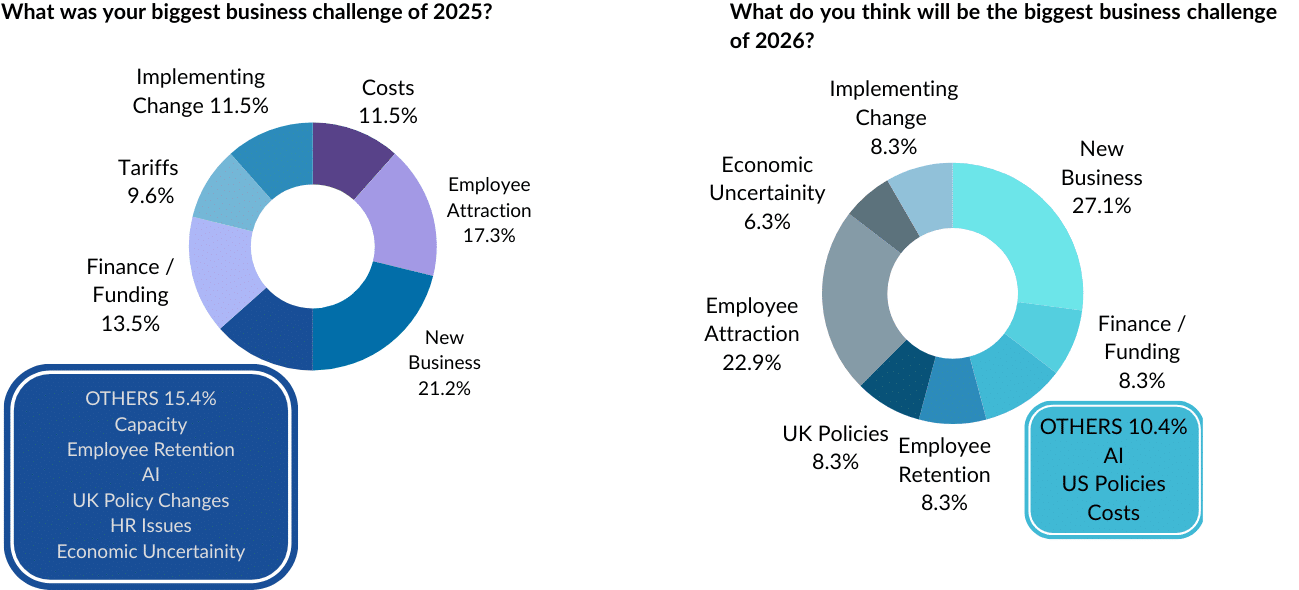
At the end of a year that proved difficult for many companies, we wanted to understand exactly what challenges businesses had faced, as well as what they expected the biggest challenge of 2026 to be.
Ahead of the Autumn Budget in November, we asked companies “How confident are you in the UK economy currently?” We then asked them that same question when gathering the data for this report, to see how the Budget had affected their view.
Jan 25
Jan 26

Our client survey shows that 2025 was a challenging year for many businesses, with people pressures and economic uncertainty featuring strongly. Issues around capacity, employee retention, HR and the growing influence of AI were common themes, alongside the impact of UK policy changes. As businesses look ahead to 2026, the focus is shifting towards growth and delivery. Securing new business, attracting, and retaining talent, controlling costs, and implementing change are expected to be the main challenges. At the same time, confidence in the UK economy has dipped since the Autumn Budget, with fewer businesses feeling positive than earlier in the year. Overall, the results underline the need for adaptability, financial resilience and a clear focus on long-term priorities as businesses move into the year ahead.
Megan Robertson, Manager, Account Management
What Else Did We Learn From Our Surveys In 2025?
Remote Working
Whilst the shift towards remote and hybrid working started by the pandemic appeared to be permanent, a UK snapshot survey by the Office for National Statistics presented a varied picture, with 26% of people saying that they had been hybrid-working in the prior seven days, with some days in the office and some days at home – while 13% had been fully remote and 41% had been fully office-based (the remainder were not working at the time).
In April, we surveyed our clients with the same set of questions on the subject that we used two years previously, to see if and how attitudes had changed, as well as why?
Do you currently offer your staff any amount of regular remote working?
What working pattern do you currently offer?
What working pattern do you currently offer?
If you would like to increase time in the office, why?
Our data suggested that the shift towards remote and hybrid working – which was initially driven by the pandemic – seemed to be evolving. When we surveyed our client base in April 2023, 90% of companies offered remote work (up from just 31% pre-pandemic), but our April 2025 survey showed a slight decline, with only 81% now offering regular remote working.
For those companies that were keen to increase time in the office, the reasons had shifted. Culture, collaboration, and training remained key drivers, but it was interesting to see those citing “culture” as the main factor, dropping from 47% to 18%, suggesting that businesses have either adapted their culture to remote work or learned to live with the impact it has had on their organisation.
There was, though, a word of warning for those companies thinking of increasing the number of days their staff work in the office – fully two thirds of the candidates we surveyed, suggested that they would consider leaving their role, if their employer asked them to increase the amount of time spent working onsite.
If you are currently working on a hybrid or remote basis would you consider leaving your role if you were asked to increase time spent in the office?
Diversity, Equity & Inclusion
Diversity, Equity and Inclusion is a topic that has been extensively discussed in boardrooms across the world, yet for some, poses significant challenges and questions. For many employers and employees, DEI is seen as crucial to fostering inclusive workplace environments that respect and value diverse perspectives, leading to innovation and growth. However, risks can arise if initiatives are not implemented effectively or are perceived as superficial. These risks include legal and reputational damage, reduced employee morale and retention, and potential backlash from employees – both actual and prospective – who feel excluded or disadvantaged. We surveyed our clients and candidates, to understand the views held on this subject, what companies are doing as they seek to create diverse and inclusive workplaces, and what the reasons are behind those initiatives.
How important is diversity and inclusion to your organisation?
What are you hoping to achieve through recruiting for diversity?
It was great to see so many of the companies we work with valuing DE&I, with legitimate reasons for doing so. However, the fact that the vast majority of respondents lacked specific goals/targets, and had nothing in place to measure the diversity of shortlists or hires, suggested that for a number of employers, it remains aspirational. Our respondents seemed well aware of this, however, with 64% telling us that they needed more support to successfully change their hiring methods.
We asked our candidates:
How important is workplace diversity and inclusion to you when applying for a role?
Have you ever withdrawn from a hiring process due to perceived lack of diversity or inclusivity?
Have you ever felt that you were treated unfairly during a recruitment process due to your identity (e.g. gender, ethnicity, disability, sexuality etc)?
If you have ever experienced discrimination during the hiring process on which protected characteristic do you feel the discrimination was based? (Multiple options could be selected)
It was interesting to see that candidates actually placed less importance on diversity and inclusion than employers, when it could perhaps have been expected to be the other way around. Also, whilst more than half of the respondents surveyed felt that they had been treated unfairly during a recruitment process as a result of their identity, only 16% had withdrawn themselves from a process as a result. With “age” and “race” highlighted as the characteristics that candidates felt most discriminated against, the importance of measuring the diversity of candidate shortlists and hires, coupled with the need for a fair and transparent process, is further highlighted.
Job Seeking
Any time spent on LinkedIn will have provided plenty of stories of well-qualified candidates, struggling to find a suitable role, highlighting clearly that employers haven’t been the only ones affected by recent economic policies and conditions.
For our final market report of 2025, we asked our candidates:
We also asked candidates “How confident are you about finding a suitable role in the current UK economy?” Whilst overall 33% of candidates are either “not very confident” or “not confident at all” about finding a suitable role in the current economy the amount of time someone has been looking does play a significant role in this perception.
It was clear from the responses we received that Looking for a job in 2025 was hard! “Fewer vacancies” was cited as the biggest challenge by those actively looking for work, and over half of the candidates surveyed suggested that their level of confidence in finding a role sat at neutral at best. It was perhaps, therefore, no surprise to see despondency setting in for those candidates whose job search had lasted more than 6 months, and it was saddening that two thirds were considering whether they may need to change sector/industry entirely, to achieve their career goals.
Thoughts from our Managing Director

The standout here is the shift in companies looking to hire permanent staff in the next 3 months and the increase of expansion as a reason for hiring. That obviously signals a real intent for growth in 2026. However, looking more deeply into the survey, confidence in the economy has actually fallen and new business has been cited as the biggest challenge for 2026 – both of which suggest that latent demand isn’t quite there yet. This means that the next few months will involve a lot of new business activity for those aspirational companies and hopefully their success can result in a shift towards a better level of growth.
Adam Palmer, Managing Director
What we achieved for our clients and candidates in 2025
We have helped 275 clients source talent that’s helped drive their business forward
We have helped hundreds of candidates on their path to their dream job
1561 vacancies worked
43 new 4 & 5* Google reviews from candidates
Continued to sponsor .NET Oxford all year
Who are Corriculo?
At Corriculo we have a passion for doing recruitment differently. We strive to deliver long-lasting relationships between candidate and recruiter that make a continued difference. Our clients benefit from over 50 years’ combined recruitment experience, specialist sector knowledge and our extensive network of industry experts.
Our mission is that by doing recruitment differently, we provide authentic, innovative and transparent recruitment solutions for clients & candidates all over the UK for permanent and contract positions. Our values are a key part of why we do what we do and we are determined to demonstrate these in all aspects of our work.
Accountability: We promote a culture of ownership, where employees are empowered to take responsibility for their work and are held accountable for delivering on their commitments.
Sharing Knowledge: Knowledge is a valuable resource that can be leveraged to drive innovation and improve performance.
Continuous Improvement: We constantly seek new ways to improve our processes and approach, in order to produce a high quality service for clients and candidates alike.
Honesty & Integrity: By prioritizing a culture of trust and accountability, we continue to build a strong reputation for ethical behavior and trustworthiness, both internally and externally.